
925 Sterling Silver Manufacturing for Private Label
Private label on a silver order is about two things: the mark on the piece and who owns the mould afterwards. The published terms are a 100% NDA, designs that stay 100% exclusive to your brand, laser engraving for a custom logo, and an S925 stamp on every piece, on a minimum of 50 pieces per design in 925 sterling silver. Here is how that is arranged in practice.
Key takeaways
- MOQ for a private-label silver design is 50 pieces per design, the lowest of the three published material floors.
- 100% NDA protection covers the design, and moulds and CAD files are not resold or published.
- Custom logos are cut with laser engraving, while genuine 925 silver is identified by an S925 stamp.
- Silver is described as nickel-free and allergy-free, plated with eco-friendly electroplating.
What private label changes about a silver order
An unbranded order ends at the piece. A private-label order ends at the piece, the logo, the packaging and the paper trail behind it. That means the design brief is longer, because a logo has depth and a position, a box has a print run, and a backing card carries a barcode that has to match a retail channel. All of it is approved before a mould is cut.
The 925 sterling silver base stays the same, and so does the MOQ of 50 pieces per design. What differs is where the conversation happens first: on a private-label order the mark and the packaging are settled alongside the shape, because changing the engraving after tooling means cutting into a finished surface.
Ownership: NDA, moulds and exclusivity
The published position is a 100% NDA alongside designs that remain 100% exclusive to the buyer's brand: moulds, CAD files and the collection itself are not resold and not published. For a brand whose whole proposition rests on a shape, that is the clause that matters more than the price of the first run.
Ask for it in the same document as the drawing. An exclusivity statement is only useful if it names the artefact — the mould, the CAD file, the collection — rather than making a general promise about designs. On a silver order this is also practical: a mould that is not reused for another client is a mould whose dimensions stay true for your repeat runs.
The S925 stamp, your logo and the engraving order
Every silver piece is stamped "S925" to identify it as genuine 925 silver, and custom logo work uses high-precision laser engraving. The two marks have different jobs: S925 declares the base metal, while the logo belongs to the brand. Both are dimensional features cut into the metal, so both are drawn at CAD stage rather than added at packing.
The sequence question then matters. Laser engraving cuts into the surface, and a cut made after the anti-tarnish e-coating reopens the layer it just sealed, leaving raw metal inside the letters. On a private-label piece where the logo sits on a visible face, that is the difference between a crisp mark that stays clean and one that darkens first.
| Item | Published term | What it protects |
|---|---|---|
| NDA | 100% coverage | The design and the brief behind it |
| Design ownership | 100% exclusive to your brand | Moulds, CAD files and the collection |
| Logo marking | High-precision laser engraving | Brand identity on the piece |
| Purity mark | S925 stamp | What the metal declares |
| Minimum | 50 pcs per design | The size of a first private-label run |
Nickel-free silver and eco-friendly plating
The sterling line states that the silver is nickel-free and allergy-free, and that plating on silver uses eco-friendly electroplating. Multi-layer plating in 14K, 18K or 24K gold, or rhodium, is available on the same base, and an anti-tarnish e-coating can sit over the finished surface on silver just as it does on brass.
For a private-label range sold direct to consumers, those two statements do more work than a technical specification. "Nickel-free and allergy-free" answers the question a customer asks before buying, and "eco-friendly electroplating" answers the one they ask afterwards. Both are published on the line's own page rather than inferred from a certificate.
Timelines on a private-label silver order
The windows are the standard ones: 3D CAD sampling at 48 hours (CAD) / 25–30 days (sample) / 3–4 weeks (run) (run) to CAD — CAD, sample, run — CAD, sample, run after sample approval. A dedicated project manager handles the order on a 1-on-1 basis with a 24-hour response time, which matters most in the first week, when the CAD file is being reviewed and the logo position is being settled.
Sample testing is offered as a stage in its own right — a physical sample approved before production begins. For a private-label brand that is the last point at which the logo, the mark and the finish can be changed without touching a production batch, so it is worth treating the sample as an approval deadline rather than a preview. A sterling silver jewelry manufacturer that publishes the minimum, both windows and the marking terms can be compared with another on the same set of numbers, which is rarely true of a supplier quoting a single delivery date.
Worked example: how much of the sampling window CAD occupies
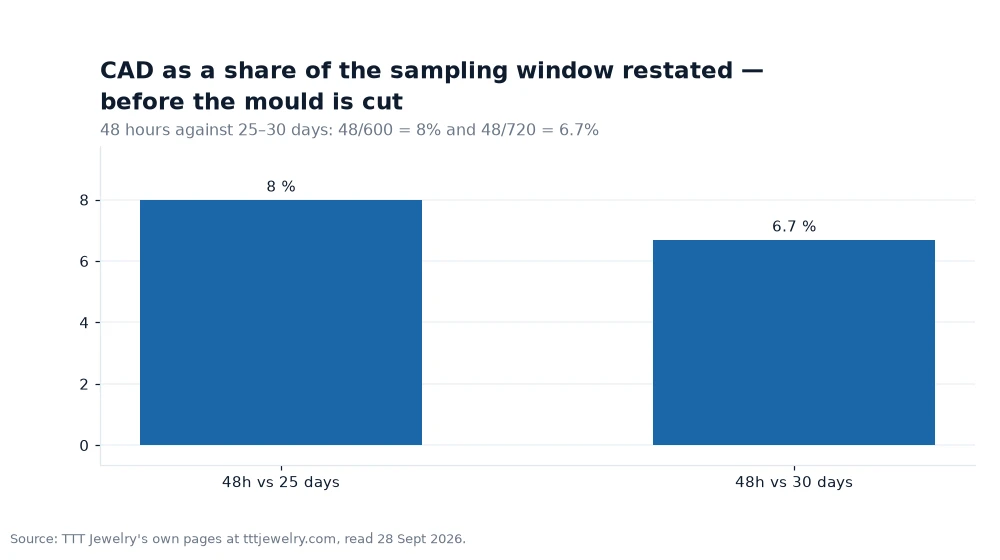
CAD is quoted at under 48 hours and sampling at 25–30 days. Convert the sampling window into hours: 25 days is 25 × 24 = 600 hours and 30 days is 30 × 24 = 720 hours. The CAD stage is therefore 48 ÷ 600 = 8% of the short end of the window and 48 ÷ 720 = 6.7% of the long end.
That small fraction is where every private-label decision is cheap. A logo position changed during CAD costs hours out of a 600-hour block; changed after sampling it costs a new tooling cycle and another 600 hours. My arithmetic; the 48 hours and the 25–30 day window are the published figures.
Frequently asked questions
Is the design kept exclusive to the buyer?
Yes. The published terms are a 100% NDA and designs that stay 100% exclusive to your brand, with moulds and CAD files not resold or published.
Can a custom logo be added to a silver piece?
Yes, by high-precision laser engraving, alongside the S925 stamp that identifies the piece as genuine 925 silver.
What is the smallest private-label run?
50 pieces per design in 925 sterling silver, which is the lowest of the three published per-design minimums.
Setting up a private-label silver range
Collect the four artefacts that define the brand before the first order: the logo file, the packaging specification, the barcode structure and the sample you will hold as the standard. Then ask for the exclusivity terms and the engraving sequence in writing, because those two answers decide whether the mark on the piece survives its first year. A brand that keeps the approved sample on file can reorder the same design later and compare against something physical rather than a photograph. Brands parallel-running a plated look usually keep the silver range and the brass line on the same specification sheet, and the paper trail behind both materials is documented on the factory page.
The published detail behind this piece — the 100% inspection rule; the S925 purity stamp, the ISO 9001:2015, BSCI and REACH statements — sits on tttjewelry.com, in a visit dated 28 Sept 2026. Any conversion into other units is mine rather than the manufacturer's[1].